
Truro, Nova Scotia – Building strong partnerships to leverage small town resources

Picture this: you’re a municipal leader in a typical small town. Resources are tight, so you don’t have much budget and can’t afford to have a dedicated staffer working on climate action. Yet you’ve completed a Community Energy and Emissions Plan, or CEEP; you’ve engaged a range of community stakeholders; you’ve developed a list of priority actions; and now you’re working on implementation.
Perhaps the best part: you’ve been able to source external funding to cover nearly everything.
It may sound like a dream, but that’s what’s happening in Truro, a small town in central Nova Scotia.
The secret to success? “Partnerships,” Alison Grant, the Town of Truro, Nova Scotia’s Manager of Strategic Initiatives and Communications, says with conviction. “They’ve been key not just in providing technical knowledge and support, but in providing funding and administrative resources too.”
To drive that message home, she adds, “Our partnerships have enabled us to do things a small community like ours would otherwise never have been able to do.”
First steps: a CEEP and CEPI
Truro’s sustainability journey started when it joined the Federation of Canadian Municipalities’ Partners for Climate Protection, a nationwide five-step framework to guide municipalities. But town leaders quickly discovered that working through the program would require more capacity and financial resources than they had available.
“So, in early 2024, we joined the Clean Foundation’s Community Climate Capacity Program – and thus began our first partnership,” Alison recounts. Clean Foundation helps communities prepare for the realities of a changing climate by protecting local environments and building more resilient places to live and work.
Clean Foundation experts were made available, and with their help Truro was able to access funding from Nova Scotia’s Low Carbon Communities Fund to create a CEEP. The CEEP was ready by fall 2024, and was adopted by Council that October.
But having a plan is just the first step; implementing it is often where bigger challenges emerge – and where larger partnerships can be beneficial.
As Scott Osmond, mitigation specialist with Clean Foundation, puts it, “We had recently started partnering with QUEST in other communities, and quickly saw how QUEST’s Net-Zero Communities Accelerator Program could complement our work and bring value. So we introduced QUEST to Truro, and the partnership was extended.”
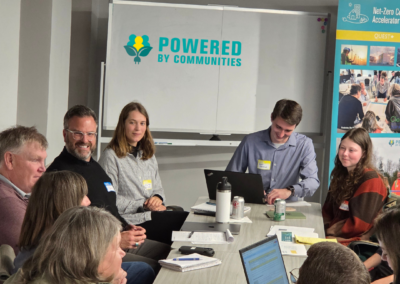
That led to a QUEST-facilitated Community Emissions Plan Implementation, or CEPI workshop in late 2024 that brought together elected leaders, staff and other community stakeholders.
“The CEPI was important because it got a wide range of people into the same room,” Alison explains. “We don’t have dedicated sustainability staff, so we really needed everyone to understand that our approach had to be ‘holistic’ – in other words, with everyone in every department engaged; with responsibility spread across existing staff and resources; and with emission reduction plans and actions integrated into everything else happening in town.”
Adding focus
For busy municipal administrators and leaders, taking climate action can be daunting – especially when there are many possibilities, and specialized knowledge is required. “Really, my expertise is local government, not sustainability,” she reflects.
So Truro first leveraged its partnership with QUEST and Clean Foundation to turn a long list of possible actions proposed in its CEEP into a short list of priorities.
“We put our heads together and looked at every option through the lens of what was doable in our community,” Alison continues. “How does this align with everything else going on? How does it align with other priorities and longer-term goals? And – is it affordable? Do we have the capacity to implement it?”
The town’s partners stepped in to help with those last two concerns. “The benefit we bring is that we add capacity to municipalities without a dedicated climate lead on staff,” says Charlotte Bourke, climate lead with Clean Foundation. “We help them access funding; plus we provide access to a team of experts and a broad network of knowledge.”
That prioritization exercise identified electrification of the town’s vehicle fleet as a top priority. “We realized it would be fairly quick to implement, and most likely to get political support and community buy-in,” Alison Grant recalls. “It meshed well into our budgets and asset management plans; we replace vehicles regularly anyway. And we were enthused by the potential for it to become a catalyst for increasing EV uptake in the larger community too.”

One more partner, with expertise and funding
But important questions soon emerged – like could the town be 100 per cent certain that EVs were up to the tasks demanded? What kind of charging infrastructure was needed, and how much would that cost? Was the business case solid? It was clear that money and expertise would be required to do the necessary groundwork.
So, QUEST introduced a new partner into the fold: the Climate Ready Infrastructure Service (CRIS), funded by the federal government and administered by the Canadian Urban Institute. It turned out to be a perfect fit.
“CRIS offers expertise and funding to help local governments with limited capacity turn priorities and goals into action,” says Portfolio Manager Dan Wassmansdorf.
“Often communities have a good project idea, but they need certainty on questions like: is this even feasible? Do we have the capacity to execute it? Are there potentially better alternatives? What surprises might we expect? How do we get numbers we can use to leverage outside funding? Where do we begin, and what are the exact steps we need to take?”
“Our program’s experts develop technical options that enable them to make good data- and climate-informed decisions about infrastructure projects,” he summarizes.
CRIS has access to funding for preliminary studies, and works with a roster of over 100 experts – engineers, consultants, urban planners and more – qualified to do the work.
And they try to make everything as easy as possible for busy municipal leaders and staff. “Our aim is to be the lowest barrier federal funding program that exists for climate change”, Dan smiles. “It takes just 20 minutes to register online with CRIS, and then a 30-minute phone call to get started.”
Alison Grant affirms how quick and easy it’s been to work with CRIS. “Within two weeks we were matched with the consultant who carried out our fleet electrification feasibility study – and they even managed all the administration on our behalf!”
It’s hoped that implementation of that project will start in 2026. And with that priority well in hand, she’s looking ahead to next projects on the list: conducting a deep retrofit of the Town’s heritage Farmers Market building; completing the town’s climate risk assessment and resilience plan; completing a regional public transit feasibility study in collaboration with neighbouring communities; and developing a community wildfire protection plan.
Partnerships, the key to success
“This partnership has been a godsend to a small municipality like ours,” Alison emphasizes. “Without our partners, we wouldn’t be nearly as successful as we are. Clean Foundation has brought capacity and expertise; QUEST Canada has brought coaching, connections, funding and pathfinding; and CRIS has brought expertise and financial resources. They’ve taken on a lot of the heavy lifting, and it’s been a happy surprise that we haven’t needed a dedicated staffer yet.”
“They’ve connected us with funding we probably wouldn’t have found out about otherwise – funding that has covered nearly 90 per cent of the costs of the environmental projects we’ve undertaken since 2024!”
Reminds Clean Foundation’s Scott Osmond: “If you’re short on capacity, finances or human resources, it’s important to know that you’re not alone – there are options to get to action.”
And it all starts with developing and leveraging smooth, complementary partnerships.
ABOUT THE AUTHOR
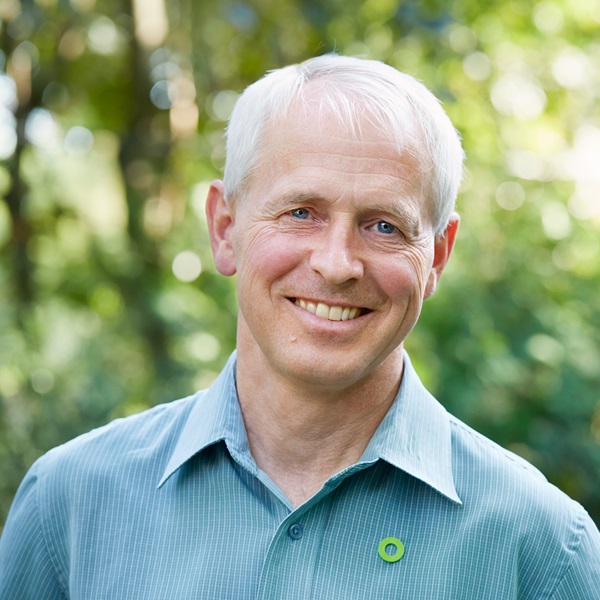
Carl Duivenvoorden
Speaker, writer and sustainability consultant Carl Duivenvoorden helps people and organizations learn how they can save money, energy and our environment. He’s presented to over 450 audiences across Atlantic Canada and the US. His column Green Ideas ran for 10 years in New Brunswick dailies, and he will now be joining CBC Radio’s Shift NB every second Monday this winter to talk energy. Carl lives in Upper Kingsclear, NB.
About Powered by Communities
Established in 2017, Powered by Communities is an awareness-raising, communications and media platform that highlights and celebrates local community energy initiatives taking place across the country, from coast to coast to coast. The platform inspires, informs and engages its readership with stories and articles detailing community energy initiatives being led by local governments, municipalities, Indigenous communities, community groups, non-profits, charities, and enterprising individuals.

About QUEST Canada
QUEST Canada is a registered Canadian charity that supports communities in Canada on their pathway to net-zero. Since 2007, we’ve been facilitating connections, empowering community champions and advising decision-makers to implement energy use and emissions reduction solutions that best meet community needs and maximize local opportunities. We develop tools and resources, convene stakeholders and rights holders, and advise decision-makers — all with the goal of encouraging, assisting and enabling communities to contribute to Canada’s net-zero goals.
Support local communities by sharing this story
MORE FROM POWERED BY COMMUNITIES



Sign Up
Join the Conversation!
Sign up to get the latest news and updates about QUEST Canada events and receive QUEST Canada's monthly newsletter.