
Net-Zero Communities on the Canadian Prairies – A Benchmarking Case Study

Featuring Ronak Patel, Program Manager, Sustainability Services – Municipal Climate Change Action Centre
Across the Canadian Prairies, local climate initiatives are emerging, shaped by each community’s unique context and needs. While local goals, priorities, and challenges may vary, a shared theme exists: people care deeply about the places they call home and want to make them more sustainable, resilient, and future‑ready. QUEST Canada’s Net‑Zero Communities Accelerator program’s NCA Prairies Cohort supports these communities in doing just that.
A group of 12 communities across the Prairie Provinces completed benchmark assessments in 2024 and 2025. These assessments offer a snapshot of where each community stands in its energy and emissions planning journey. The benchmark scores are shared in First Steps Toward Net-Zero Communities – A Benchmarking Case Study, published by QUEST Canada.
But there is a bigger story about collaboration, capacity building, and local leadership behind the numbers.
For Ronak Patel, Program Manager, Sustainability Services at Alberta Municipalities, this work is as much about empowering people as it is about lowering emissions. “My focus really is on capacity building,” he says. “Education, planning, staffing – these sort of supports that we provide to communities… build their foundation for climate action.”
The NCA Prairies Cohort demonstrates the diversity of local governments. “We have fairly large cities. We have very small towns. We have First Nations communities,” Ronak notes about this group. That diversity is both a complexity and an opportunity – expanding the range of ideas, resources, and approaches that can be shared across the cohort. He and team members at Alberta Municipalities have been supporting Albertan participants in the cohort through the Municipal Climate Change Action Centre.
Local priorities also vary widely. Some communities are drawn to climate action for environmental reasons. Others are driven by economic considerations, energy security, or the chance to deliver tangible benefits like improved mobility or better infrastructure. This reinforces a core principle of the NCA program: climate action resonates most when it is rooted in local context. “Whatever the local priority is, we frame climate action through that lens,” Ronak adds.
Different starting points, one thing in common
Even with different starting points, motivations, and capacities, communities across the Canadian Prairies have one thing in common: a need for support. Local governments often operate with limited staff, limited resources, and vast geographic areas to serve. The purpose of the NCA program is not to prescribe solutions, but to partner with communities where they are and help them move forward.
The benchmark assessments completed by the Prairies cohort offer an implementation‑focused baseline. They reflect a community’s current policies, systems, and initiatives, independent of who completed the report. Report authors/contributors can include municipal departments, local utilities, Indigenous organizations, nonprofits, or grassroots groups.
“Many of the scores are agnostic of who does the work,” Ronak highlights, “as long as progress is happening in that space.”

First Steps Toward Net-Zero Communities – A Benchmarking Case Study highlights momentum behind sustainability efforts. Some communities are starting to develop strategies, while others are moving forward with implementation. Labelling communities as Leaders, Doers, or Seekers helps customize support rather than rank participants. “The benchmark isn’t about rankings,” he emphasizes. “It’s about understanding starting points and supporting growth.”
This approach supports each community in making meaningful progress toward net-zero, specific to their strengths and areas for opportunities.
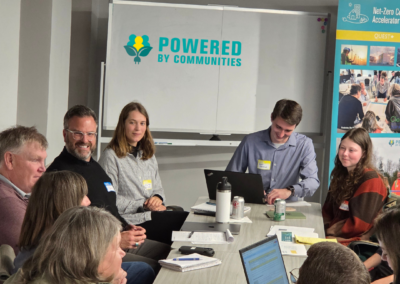
Collaboration is also central to the Prairies experience. The NCA program holds regular, online meetings with the primary contacts from each participating community to move the work forward, but gathering in person was a key program design. “In almost every workshop that we hosted,” he shares, “there were a great number of stakeholders who came to support the energy planning work that we were doing.”
“It was really inspiring to see each of the communities bring multiple departments from their municipality, as well as, in some cases, external stakeholders.”
The reality is that a lot of work is really being done at the grassroot level. The City of Lethbridge stands out in his memory: municipal staff, nonprofit organizations like Environment Lethbridge, developers, building sector advocates, and utility providers all filled the room. “This really highlights the context of this work not just being something for the municipality,” Ronak emphasises, “but something that is for the region.”
Cohorts create a space
Many climate practitioners feel isolated, and meeting others with similar challenges can be very valuable. Cohorts also create a space to collaborate, especially when there are limited opportunities to connect across community borders.
Networks like the Alberta Climate Leaders Staff Peer Network enable staff to connect, learn, and collaborate effectively on climate action. “This work is complex, it is challenging, it can be hard to do,” Ronak reveals. “Being together reminds you that everyone is working on this together. You’re not siloed by yourself. There’s support happening across different industries, and you can reach out and ask questions and be able to really feel like you’re working collectively on a bigger problem.”
As seen in Pincher Creek – Commitment and a solid plan yield quick paybacks, the value of collaboration is especially visible. The Town and the Municipal District participated jointly in the program – a partnership that contributed to them earning the highest governance indicator score in the cohort. Their cross‑sector, inter‑municipal approach illustrates how climate action can transcend boundaries, both geographic and organizational.
Across the Prairies, the highest-scoring indicators, Data and Transportation, reveal meaningful insights about where communities already have momentum. Many communities track their greenhouse gas emissions and set reduction targets, frequently collaborating with utilities to gather energy use data. These standardized methods provide a solid basis for effective planning.
Transportation-related initiatives also tend to receive higher scores. Efforts like promoting active transportation or enhancing transit services often fit well with local priorities and offer additional social benefits. Practical steps, like active transportation and public transport, are feasible for communities now, whereas more complex solutions – such as major energy retrofits or constructing net-zero buildings – require more time and resources to implement.
Lower scores highlight opportunities
As the cohort winds down, Canadian Prairie communities will complete a re-benchmarking process to evaluate their progress over the course of the program. Lower scores in strategy and buildings highlight areas for improvement, giving communities a better understanding of their needs and growth opportunities.
The Municipal Climate Change Action Centre will be watching for growth over 2 years in areas such as strategy, data, and the integration of mitigation and adaptation. The vision for progress is clear: implementation‑ready plans, stronger policies, and a more holistic approach to resilience and emissions reduction. But ultimately, his hope for the case study, and this story, is about inspiration and empowerment.
The throughline of this work on the Prairies story isn’t the numbers, statistics, or lists of indicators, but the collaboration of communities working together to create a sustainable future.
“We’re hoping that this Case Study can help kick-start that journey, help folks prioritize actions,” Ronak concludes, “and really serve as an inspirational piece, as well as help find support from third-party areas for policy or funding.”
Read First Steps Toward Net-Zero Communities – A Benchmarking Case Study.
ABOUT RONAK

Ronak Patel
Ronak works at Alberta Municipalities as a Program Manager in Sustainability Services, helping communities build capacity for climate action through the Municipal Climate Change Action Centre. Working on education, technical support, and funding programs, he focuses on making complex ideas useful, practical, and sometimes even fun. Ronak lives in Treaty 6 territory and the homelands of Métis people in Edmonton, AB.
About Powered by Communities
Established in 2017, Powered by Communities is an awareness-raising, communications and media platform that highlights and celebrates local community energy initiatives taking place across the country, from coast to coast to coast. The platform inspires, informs and engages its readership with stories and articles detailing community energy initiatives being led by local governments, municipalities, Indigenous communities, community groups, non-profits, charities, and enterprising individuals.

About QUEST Canada
QUEST Canada is a registered Canadian charity that supports communities in Canada on their pathway to net-zero. Since 2007, we’ve been facilitating connections, empowering community champions and advising decision-makers to implement energy use and emissions reduction solutions that best meet community needs and maximize local opportunities. We develop tools and resources, convene stakeholders and rights holders, and advise decision-makers — all with the goal of encouraging, assisting and enabling communities to contribute to Canada’s net-zero goals.
Support local communities by sharing this story
MORE FROM POWERED BY COMMUNITIES



Sign Up
Join the Conversation!
Sign up to get the latest news and updates about QUEST Canada events and receive QUEST Canada's monthly newsletter.