
The Municipality of Colchester, NS – Leveraging Capacity for Successful Climate Action

When you talk to Joanna Burris, you quickly notice two things: her enthusiasm for her role as Sustainability Planner for the Municipality of Colchester, Nova Scotia; and how often the word ‘capacity’ surfaces in the conversation.
“I guess I use that word a lot,” she laughs. “But it’s a real issue for a community like ours. There are so many things we need to do so quickly!”
Burris was hired in 2018 as the Municipality’s first Sustainability Planner. One of her early priorities was to work with a consultant and a committee of dedicated volunteers to complete a Community Energy and Emissions Plan (CEEP). Corporate and community emissions inventories were taken, and an action plan was developed for reaching net-zero emissions by 2050. The committee’s final report, Carbon-Free Colchester, was endorsed by the Mayor and Council in 2022 and now serves as a roadmap to guide the Municipality’s emission reduction initiatives.
“We’ve been lucky to work with both Clean Foundation and QUEST, to help leverage our resources and increase our capacity,” says Burris.
Clean Foundation is a non-profit climate change organization that brings specialized teams together to work on climate solutions and capacity building across the Atlantic Region.
“Clean Foundation’s Community Climate Capacity Program has been hugely helpful,” Burris shares. “Through it, we’ve gotten access to a dedicated team of specialists who are helping us in our climate and sustainability efforts. It’s increased our capacity to get things done.”
The team supporting Colchester is comprised of Teal Burns, Climate Lead; Scott Osmond, Mitigation Specialist; and Brendan Piper, Community Energy Project Lead.
And it was Clean Foundation that brought QUEST into the collaboration in 2024. “When we learned about QUEST’s Net-Zero Communities Accelerator Program, we immediately saw how it meshed with our work and could save our partner communities time and money,” relates Osmond. “So we introduced it, and several communities – including Colchester – quickly came on board.”
“QUEST’s Benchmark Assessment tool has been especially helpful,” says Burns. “It’s an engaging process that helps a community clarify where it is at, and where it needs to go.”
A turning point
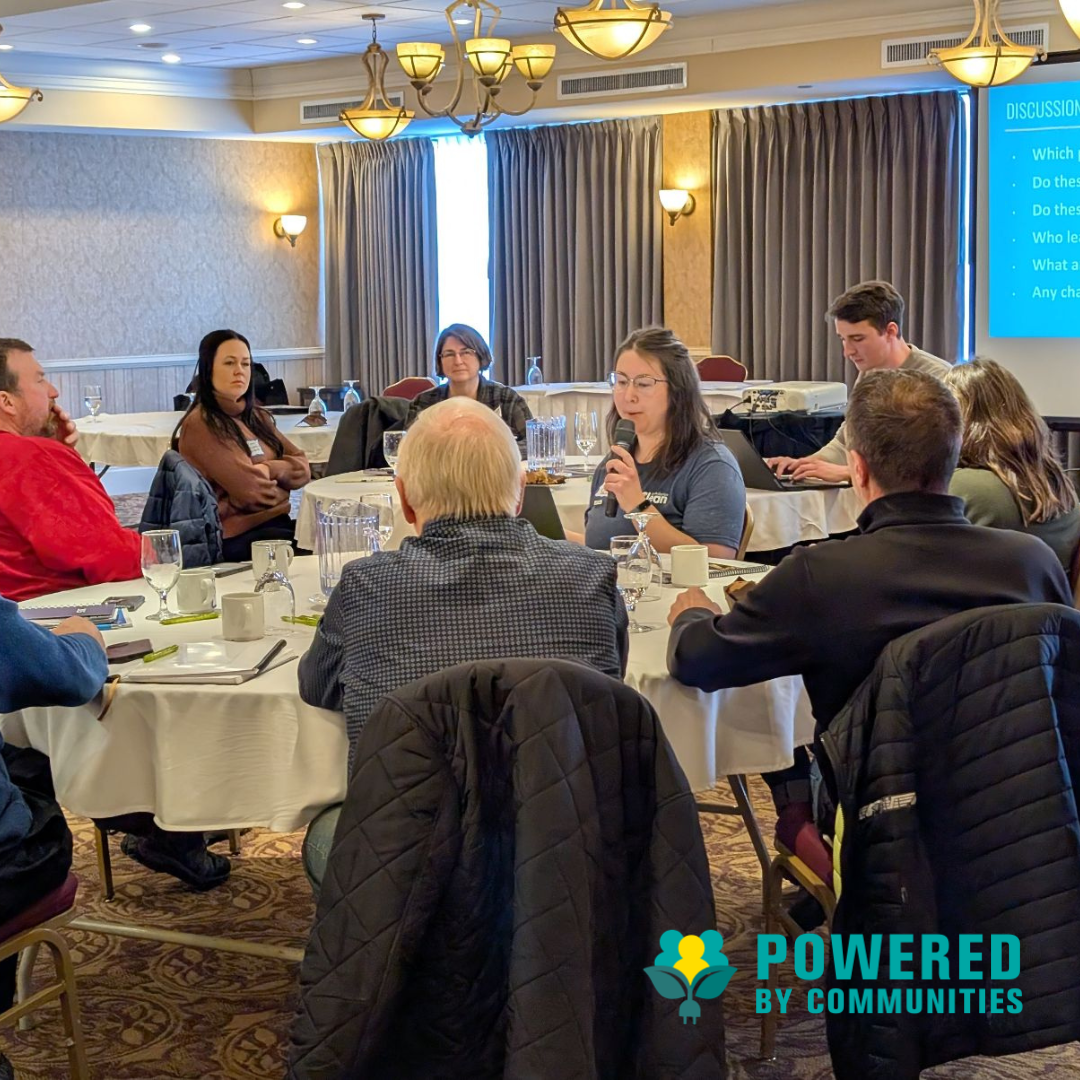
Pivotal in the Municipality of Colchester’s transition from planning to implementation was a Community Emissions Plan Implementation (CEPI) workshop held in early 2025. Facilitated by QUEST’s Senior Project Lead Eddie Oldfield, it brought more than 50 elected leaders, municipal staff and engaged citizens together in the same room to chart a way forward.
“That workshop was a fabulous opportunity to get everyone onboard and on the same page,” Burris recalls. “Because it was led by someone outside our community, it created a sense of collective ownership and across-the-board action, rather than one department telling everyone else what they needed to do.”
“The day involved networking, brainstorming, small group discussions, idea sharing – all kinds of interaction, to build understanding, commitment and ownership.”
“In smaller municipalities, it often falls on one person to try to execute all the planned actions,” says Clean Foundation’s Piper. “The CEPI session helped everyone see that true success depends on everyone being engaged, even if it’s not part of their official responsibilities.”
Adds Osmond: “People came away with a clear understanding that climate change action isn’t restricted to a department; it’s part of everyone’s role.”
Next step: Action
In the wake of the CEPI workshop, Burris and her colleagues are juggling several exciting projects. Perhaps the biggest is the development of a new community solar garden.
“As a priority action identified in our CEEP, it already had municipal support,” Burris explains, “So it was a logical early priority.”
Solar gardens are large grid-tied solar arrays built by municipalities, businesses or other organizations that sell subscriptions of renewable energy to local homeowners and businesses.
“Part of the appeal of solar gardens is that they make renewable energy available to people who can’t install their own solar panels – like renters or people with shaded roofs,” Piper explains. “They’re also an opportunity to address energy poverty by providing subscriptions to low-income households who otherwise cannot access renewable energy options.”
In the meantime, as the feasibility of the solar garden is studied, another large solar array was recently commissioned at one of the municipality’s wastewater treatment plants. “It’s very visible from the road, so it’s attracting a lot of attention and excitement,” says Deputy Mayor Laurie Sandeson, a strong proponent of climate action. Solar panels were also installed at a library in 2023, and arrays will be installed at two rural arenas this year.
Also underway is a major study on public transit options for the sprawling municipality, in partnership with the Town of Truro, the region’s urban hub. “Exploring public transit options is also one of the top priorities in our CEEP,” says Burris. “We’ve asked our consultant on the project to be creative: to look at fixed route service, transit-on-demand, car sharing, ridesharing or any other option that could help meet the diverse needs of our community.”
The municipality operates two very successful Property Assessed Clean Energy (PACE) programs, Solar Colchester and Cozy Colchester. The first supports the installation of solar systems; the second helps homeowners make energy efficiency upgrades like insulating, replacing windows and installing heat pumps. Both programs offer homeowners low-interest financing for their upgrades, secured against their property. Over 200 households have participated in the programs so far.
Level 2 EV chargers have been installed in seven locations across the Municipality. Energy efficiency audits have been conducted of all municipally owned facilities.
Next items on the priority list include an implementation strategy for electric fleet vehicles; the development of a sustainable procurement policy; and exploration of green development standards for Colchester. Burris’ team is also working with other departments and the Clean Foundation to advance climate adaptation and community resilience priorities.
Takeaways
Despite capacity challenges, Burris is pleased with the progress her team has made.
“We’ve definitely gained momentum since hiring a dedicated PACE Program Coordinator in 2022, and since working with Clean Foundation and QUEST,” she explains. “With the QUEST implementation workshop in February, I think we’re in an even better position to move forward on many of our planned actions.”
So what can other communities learn from Colchester’s experience to date?
“Use every resource you can get your hands on, from templates to expertise,” suggests Burns. “And take full advantage of networking opportunities. QUEST’s Community of Practice has been especially helpful in bringing free expertise to municipal leaders and staff.”
“People – whether municipal staff or members of the public – engage with things they can relate to, specific projects relevant to their needs,” Burris reflects. “And it’s critical to involve them early in the process, so they feel heard.” No doubt that approach is partly why nearly a dozen staff recently stepped up to join a new wildfire resilience working group, and why an online transit survey generated over 1000 responses in its first week.
“I wish we could clone her, but we can’t!” Sandeson jokes of Burris. “So it’s important to leverage as much outside help as we can, as we’re doing with Clean Foundation and QUEST.”
All in the name of increasing the capacity of a rural municipality on a determined mission of sustainability.
ABOUT THE AUTHOR
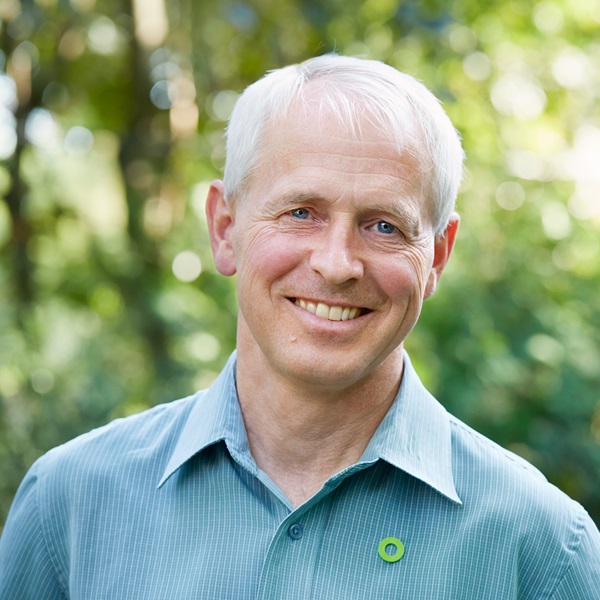
Carl Duivenvoorden
About Powered by Communities
Established in 2017, Powered by Communities is an awareness-raising, communications and media platform that highlights and celebrates local community energy initiatives taking place across the country, from coast to coast to coast. The platform inspires, informs and engages its readership with stories and articles detailing community energy initiatives being led by local governments, municipalities, Indigenous communities, community groups, non-profits, charities, and enterprising individuals.

About QUEST Canada
QUEST Canada is a registered Canadian charity that supports communities in Canada on their pathway to net-zero. Since 2007, we’ve been facilitating connections, empowering community champions and advising decision-makers to implement energy use and emissions reduction solutions that best meet community needs and maximize local opportunities. We develop tools and resources, convene stakeholders and rights holders, and advise decision-makers — all with the goal of encouraging, assisting and enabling communities to contribute to Canada’s net-zero goals.
Support local communities by sharing this story
MORE FROM POWERED BY COMMUNITIES



Sign Up
Join the Conversation!
Sign up to get the latest news and updates about QUEST Canada events and receive QUEST Canada's monthly newsletter.