
News Release
Innovation Assessment Report Shows National Low-Carbon Energy Strengths, and Clear Provincial and Territorial Paths Forward to Net-Zero
Attn: Low-Carbon Energy / Energy Transition / Innovation Editors and Writers
June 12, 2025 // A transformation in how energy is generated, distributed, and used, is necessary to develop low-carbon energy systems that can improve Canada’s economy and reduce emissions. However, current regulatory and market frameworks hinder the development and deployment of low-carbon innovations needed.
To open more access to low-carbon energy innovation across the country, QUEST Canada and Pollution Probe have developed a National Low-Carbon Energy Innovation Assessment which identifies strengths and gaps and highlights successful pathways forward in each jurisdiction.
“Most provinces are active in climate action and are on a path toward achieving a net-zero economy by 2040,” says Richard Carlson, Director, Energy with Pollution Probe. “And they are creating opportunities for innovation in this direction.”
“However, to further enhance progress and drive innovation toward net-zero energy systems,” he points out, “every province and territory can still prioritize developing sector-specific pathways, modernizing the regulatory system to allow for greater innovation, and ensuring that all Canadians can participate in and benefit from low-carbon energy innovation.”
The Report reveals the path forward to a low-emissions economy is clear: scale innovation, remove barriers, and invest in the people and systems that are here now, and ready for what’s next.
“This assessment shows where Canada is ready to lead in low-carbon energy, and where we’re still falling short,” says Tonja Leach, Executive Director of QUEST Canada. “Key conditions like regulatory flexibility, workforce planning, and equity supports are still missing in many jurisdictions.”
“To turn ambition into impact, governments need to enact stable policy that supports innovation at every stage, from early ideas to real-world deployment.”
– 30 –
ASSESSMENT RESULTS HIGHLIGHTS
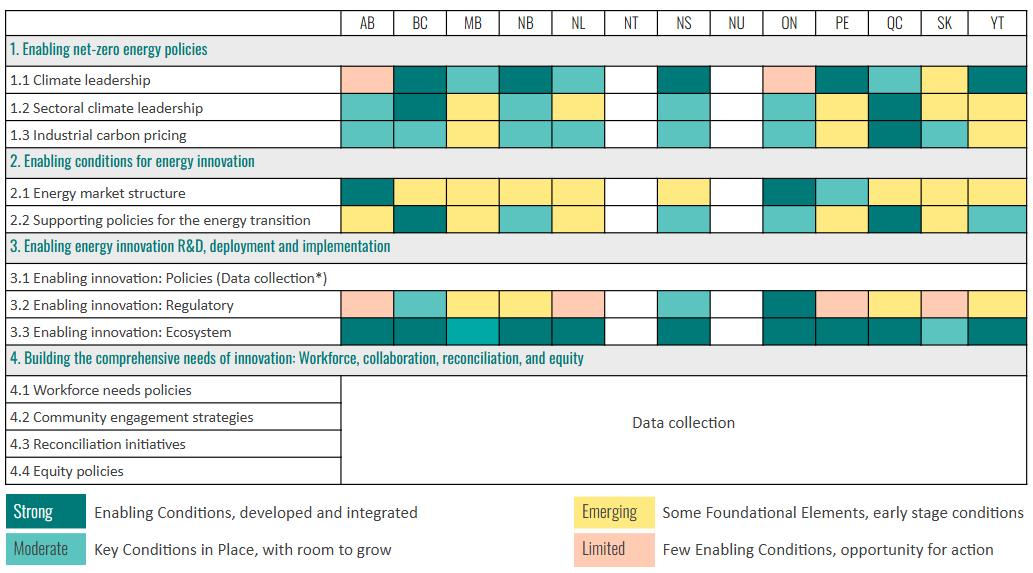
Policy Area 1: Enabling net-zero energy policies
Key national findings:
- Strong 2030 climate plans, but lacking 2050 strategies
- Sectoral planning remains siloed
- Carbon pricing revenue lacks net-zero alignment
Best provincial/territorial practices:
- PE: Long-term climate plan targets net-zero by 2040.
- YT: The Clean Energy Act sets a target of net zero by 2050, with 2030 GHG reduction targets, renewable heating goals, and ZEV sales/lease targets.
- QC: Carbon revenues fund the 2030 Green Economy Plan and past climate commitments.
Policy Area 2: Enabling conditions for energy innovation
Key national findings:
- Market structures help in shaping innovation potential
- Energy transition policies are in progress and may drive innovation
Best provincial/territorial practices:
- AB: A competitive energy market drives innovation through diverse supply and retail options.
- ON: Performance-based regulation links distributor earnings to consumer value.
- BC: 15% renewable gas target in the system by 2030.
Policy Area 3: Enabling energy innovation R&D, deployment and implementation
Key national findings:
- Low-carbon innovation policies remain incomplete
- Regulatory support is limited
- Innovation ecosystems are present in many jurisdictions
Best provincial/territorial practices:
- ON: OEB’s Innovation Sandbox supports pilot projects and enquiry services.
- MB: Efficiency Act promotes innovation in demand-side management, energy savings, and GHG reduction.
- NS: Innovation Justification Criteria allows approval of projects that lower costs, improve reliability, and support policies using proven technologies.
Policy Area 4: Building the comprehensive needs of innovation — Workforce, collaboration, reconciliation, and equity
Key national findings:
- Workforce policies for future needs are still limited
- Low-income energy policies exist, but targeted support for marginalized communities is still limited
Best provincial/territorial practices:
- BC: Workforce policies focus on training for clean energy jobs.
- NB: Supports local environmental projects through its Environmental Trust Fund.
- YT: IPP policies require at least 50% of projects to have a Yukon First Nation ownership component.
- NL: A new commercial framework for IPP in isolated communities to help offset the financial aspect of renewable projects.
***
SIX CONCLUSIONS TO ENABLING GREATER INNOVATION
Canada is a diverse country, and every province and territory is at its own place in the energy transition journey. Despite this diversity, drawing on insights from the assessment, and the identification of best practices, there are six conclusions that highlight areas where Canada must improve if it wants to fully capture the value of becoming a low-emissions economy:
Align climate policy and market signals
Low-carbon innovation thrives in competitive energy markets, but only when backed by stable, credible policy. Investors and innovators need consistent, long-term climate policy to make confident decisions. Uncertainty is holding back progress.
Modernize energy regulation to enable innovation
Outdated regulatory frameworks hinder innovation. Canada’s provinces and territories need smarter regulatory frameworks that balance customer protection with flexibility, including advanced rate systems and performance-based models that reward results, not just compliance.
Plan energy systems holistically
Effective energy planning must look beyond silos. Integrated, cross-sectoral plans are key to identifying where emissions reductions can have the greatest impact and where innovation can unlock cost savings. Sectoral climate leadership starts with a systems view.
Prioritize thermal energy innovation
Canada’s decarbonization efforts often over-focus on electricity, while overlooking heating, which accounts for the major share of energy use. Innovation in clean thermal energy is essential for a full transition to a low-emissions economy.
Put Indigenous inclusion in the center
Innovation must be inclusive. Indigenous communities are key partners in Canada’s energy future, as energy projects impact their lands and economies. Early, meaningful engagement builds trust, enables social acceptance, and long-term partnerships that drive shared success.
Build the skilled workforce the transition requires
Canada needs a skilled workforce ready to build, install, maintain, and manage a new energy system, and fast. This means not just training for today’s needs but anticipating tomorrow’s skills. Investment in education and re-skilling must match the ambition of the transition.
***
AUTHORS’ NOTE
The content of this report reflects an independent assessment by QUEST Canada and Pollution Probe Foundation and does not imply endorsement by any individual jurisdiction, organization, or funder. The findings and analysis presented are based on publicly available information and jurisdictional engagement conducted throughout the Low-Carbon Energy Initiative (LCEI) and its projects. While efforts were made to invite input from all provinces and territories, not all jurisdictions provided feedback or validated the results.
More information:
Low Carbon Energy Innovation | QUEST Canada & Pollution Probe
Media contacts:
Richard Carlson, Director, Energy, Pollution Probe
rcarlson@pollutionprobe.org / 416-926-1907, #251
Donald Wiedman, Senior Lead, Communications, QUEST Canada
dwiedman@questcanada.org / 866-494-2770, #702
Report prepared by:


Share this Release
Sign Up
Join the Conversation!
Sign up to get the latest news and updates about QUEST Canada events and receive QUEST Canada's monthly newsletter.