FROM Plans to Projects – Accelerating project-ready capacity for energy initiatives
By Scott Osmond
Across Atlantic Canada, communities, municipalities and Indigenous organizations face challenges to turn their energy transition plans into projects. Funding gaps, navigating regulatory and utility hurdles, competing priorities, limited support from decision-makers and residents, and a lack of subject matter expertise too often stall the process.
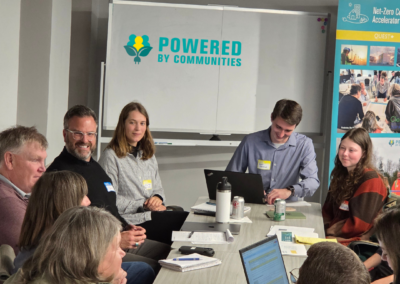
In early November 2025, QUEST Canada tackled this challenge with a two-day Project Initiation Workshop at the Halifax Convention Centre. The event brought together municipal staff representatives from the four Atlantic provinces, each ready to discuss a project in development.
With a shared goal of identifying practical steps to move community projects from vision into action, several organizations supported the workshop, with Clean Foundation providing facilitation and subject matter expertise in energy efficiency and transportation electrification.
The workshop, generously supported by ADAPTR, succeeded by connecting participants with other municipal project developers, industry partners and subject matter experts. Through panels, breakout sessions and networking, participants also gained tools, resources and strategies to overcome barriers and move projects from planning to implementation.
Day One
QUEST’s Manager, Community Energy and Projects, Seth Leon opened the event outlining the game plan and collective expectations for the two days. The full room reflected the strong demand for practical guidance on energy projects.
Tonja Leach, QUEST’s Executive Director, then reinforced the Plans to Projects Workshop’s purpose, emphasizing, “Community trust is the key to taking every vision, every net-zero plan, and turning it into a completed project.”
Tonja called for the standardization of decision-making tools, like sustainable energy project templates and models, that can “de-risk” projects for funders, utilities and regulators by being easily adapted to local contexts. “Less distraction, greater aggregation and more standardization,” she urged, stressing that while every community is unique, the path to project implementation often follows a similar path.
Her challenge to participants was clear: “Standardization will help communities move from plans to projects, at the pace the Canada of today needs.”
Panel 1: Navigating the Regulatory Landscape
Regulatory complexities remain one of the most persistent barriers for municipalities and Indigenous communities. From council approvals and land-use bylaws to procurement rules, environmental permitting and federal regulations, the process can be daunting.
Tina Northup of East Coast Environmental Law led a panel with Tonja Leach, consultant Joshua Gillespie, Building to Zero Exchange’s Taylor Owen, and Guy Wellard of Cox & Palmer Law, on strategies to navigate the regulatory landscape.
Key insights:
- Engage early: Consult with communities, councils, utilities and underrepresented groups to build buy-in and reduce resistance.
- Form partnerships: Work with consultants, technical experts and local organizations to clarify timelines, governance and financial planning.
- Aggregate projects: Regional collaboration with other communities, commercial partners and non-profit organizations can improve financial viability and reduce risk.
- Understand the rules: Map regulatory pathways, learn from similar projects and engage governing bodies early. Determine the appropriate order of operations, understand it, then follow it.
- Share lessons: Failures teach as much as successes. Panelists highlighted the potential of distributed energy resources and community energy systems to support local grids and called for policy development.
- Leverage local incentives: Temporary tax break for renewable energy projects and community benefit agreements can deliver long-term benefits from partnerships with private developers.
Panel 2: Financing Net-Zero Projects
Securing funding is another major hurdle for energy and emission reduction projects. Public scrutiny, fragmented governance and rigid regulations can be limiting.
Eric Visser from Vancouver City Savings Credit Union led a panel with consultant Rochelle Owen, Derek Peters from Ameresco, and Ashley Jones from la Société de financement et d’accompagnement en performance énergétique. The panel explored practical and emerging financing models for community-scale energy projects, with a focus on how municipalities and Indigenous communities can leverage social finance, private capital and performance-based investment structures to advance decarbonization goals.
Panelist-outlined solutions and strategies:
- Empower local actors: Schools, businesses, and community organizations can embed sustainable practices early to drive long-term decarbonization.
- Prepare for funding: “Project readiness is critical,” panelists stressed. Prepare projects before funding opens. Consult technical experts early to identify gaps and assess feasibility. Use insights learned from standardized templates, replicable projects and lessons learned to improve funder confidence.
- Demonstrate co-benefits: Health, autonomy and resilience are important alongside emissions reduction.
- Pair investments: Combine short-payback measures with longer-payback investments to improve overall returns.
- Integrate plans: Connect energy projects to broader community strategies to justify long-term investment.
Both communities and funders aim to reduce project risk. Clear project vision, thorough preparation and technical rigor are essential.
Addressing unknowns:
Hassan Shahriar from ADAPTR outlined strategies for managing uncertainty in energy projects. He emphasized that decisions often begin with available and reliable options before considering cost, convenience and societal benefits. Infrastructure limitations, such as grid capacity, often require creative solutions. ADAPTR’s Grid Adapter was showcased as one example to overcome constraints.

Working sessions
Breakout sessions grouped projects by themes, such as community solar, electric vehicle adoption, and energy efficiency. In small groups, participants reviewed their projects with rotating experts to tackle issues from project scoping and financing to contractor engagement and risk management. These experts brought perspectives from Efficiency Nova Scotia, Clean Foundation, EastPoint, ADAPTR and Ameresco, among others.
Projects discussed ranged from early concepts to those already in construction, fostering collaboration, knowledge exchange and long-term professional connections.
Day One ended with networking, enabling participants and experts to build relationships beyond the formal setting.
Day Two
Panel 3: Bridging the Gap to Net-Zero Procurement
Procurement can accelerate or impede a project. This panel underscored the importance of translating a project’s scope into actionable roadmaps with clear governance, roles, communication and next steps.
Panelists included Ben Taylor of Bird Construction, Building Efficiency Resources’ Natasha Brooks, Equalize Power’s Robert Chen, Matt Adams from Nova Scotia Community College, and Building to Zero Exchange’s Taylor Owen.
Key insights:
- Build expertise: Maintain databases of consultants, contractors and technical experts to match skills with community needs.
- Write clear Requests for Proposals:
- Provide sufficient data for accurate quotes and timelines.
- Include detailed site information to reduce cost contingencies.
- State clear project goals.
- Leverage lessons from other communities to reduce your project risk.
- Avoid issuing RFPs during peak periods (October–December).
- Align early: Assemble project teams upfront to align goals, budgets and ensure clear roles and responsibilities.
Working sessions
Participants revisited their projects in small groups. They focused on scope, deliverables, risks, and next steps to identify immediate actions for initial traction and sustain the knowledge gained and relationships built during the workshop.
Key themes:
- Shared challenges: Despite unique contexts communities face similar barriers – permitting delays, financing hurdles, governance issues and limited internal capacity were common across projects.
- Partnerships and collaboration: Effective collaboration, shared case studies and applying lessons learned can reduce risk, improve funder confidence and accelerate project timelines.
- Change is underway: Atlantic Canadian communities represented in the workshop demonstrated very strong commitment, and a clear drive to advance their resilience and energy goals.
At the end of the days
Despite diverse governance structures, participants shared common barriers and solutions, and QUEST Canada’s Plans to Projects Workshop brought together municipalities and Indigenous communities from the four Atlantic provinces to help move projects from planning to implementation.
Partnerships, collaboration and knowledge sharing were identified as critical tools to de-risk projects, build confidence with funders and regulators and accelerate implementation.
While tailored support remains essential, participants left with practical guidance, new contacts and renewed motivation to advance their projects. They returned to their communities with a shared understanding that they are not navigating these challenges in isolation, but as part of a broader network supported by expertise and collaboration.
Most encouragingly, the Project Initiation Workshop highlighted that meaningful change is already underway across Atlantic Canadian communities.
ABOUT THE AUTHOR

Scott Osmond
About Powered by Communities
Established in 2017, Powered by Communities is an awareness-raising, communications and media platform that highlights and celebrates local community energy initiatives taking place across the country, from coast to coast to coast. The platform inspires, informs and engages its readership with stories and articles detailing community energy initiatives being led by local governments, municipalities, Indigenous communities, community groups, non-profits, charities, and enterprising individuals.

About QUEST Canada
QUEST Canada is a registered Canadian charity that supports communities in Canada on their pathway to net-zero. Since 2007, we’ve been facilitating connections, empowering community champions and advising decision-makers to implement energy use and emissions reduction solutions that best meet community needs and maximize local opportunities. We develop tools and resources, convene stakeholders and rights holders, and advise decision-makers — all with the goal of encouraging, assisting and enabling communities to contribute to Canada’s net-zero goals.
Support local communities by sharing this story
MORE FROM POWERED BY COMMUNITIES



Sign Up
Join the Conversation!
Sign up to get the latest news and updates about QUEST Canada events and receive QUEST Canada's monthly newsletter.